
Study Reference
Title
GMP manufacturing of cell and gene therapy products: Challenges, opportunities, and pathways forward
Journal
Molecular Therapy (2025)
Statement
This summary is based on the original publication and includes application-oriented discussion for educational and academic reference purposes only. It is not intended as medical advice.
Summary
1. Introduction: The Golden State’s Biotech Paradox
California is the undisputed heavyweight champion of biotechnology. It is the industry’s ancestral home, anchored by the intellectual gravity of UCSF and Stanford, and currently commands a staggering 50% of all biotech venture capital in the United States. Furthermore, the state has “put its money where its mouth is,” through initiatives like the California Institute for Regenerative Medicine (CIRM), which has roughly $3.5 billion at its disposal to fuel the next generation of cures.
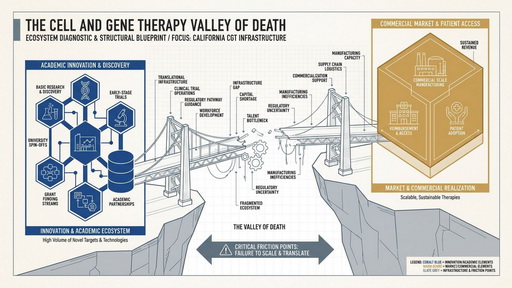
Yet, despite this embarrassment of riches, the “Golden State” is caught in a profound paradox. While it produces groundbreaking papers and billion-dollar valuations at a record pace, it is struggling to scale the actual products. There is a widening chasm between a breakthrough in a Petri dish and a finished, clinical-grade therapeutic. We are witnessing a systemic failure to bridge the gap between discovery and delivery—a manufacturing mirage where wealth and talent exist, but the “physical exit” remains blocked.
2. The $50 Million Barrier and the 65% Idle Paradox
In Cell and Gene Therapy (CGT), the transition from lab bench to clinical trial is blocked by a $50 million wall. That is the baseline cost for building a Good Manufacturing Practice (GMP) facility. For small and medium-sized enterprises (SMEs), this capital requirement is a “Death Valley” where promising science goes to die.
However, the real tragedy isn’t just the cost—it’s the inefficiency. While startups are starving for space, approximately 65% of private manufacturing capacity in the sector currently sits idle or underutilized. This is a massive brokerage and cooperation failure. Large Contract Development and Manufacturing Organizations (CDMOs) view SME cases as “crumbs” not worth the overhead, while academic labs are capped at producing doses for fewer than 10 patients when a viable trial needs 30 or more. This “California Fragmentation” mirrors the struggles seen in other hubs like Taiwan, where the inability to bridge university research with industrial-scale production creates a bottleneck that no amount of R&D funding can solve.
3. The Academic Trap: “Defense” Mindsets and Regulatory Waste
A primary driver of “California Friction” is the reliance on academic leadership for industrial-scale manufacturing. Many of the state’s 15 GMP facilities are department extensions led by brilliant professors who lack professional Regulatory Affairs (RA) and Quality Assurance (QA) experience.
This manifests in a measurable lag: an IND (Investigational New Drug) submission in California typically takes 15 to 18 months, compared to 12 to 14 months in more “offense-oriented” regions. The delay is often a byproduct of a fundamental misunderstanding of the regulatory roadmap. The FDA is increasingly exasperated by academic packages that attempt to apply “Phase 3-level validation” to “Phase 1 trials.” It is a catastrophic waste of time and capital that treats early-stage safety trials with the rigid documentation required for final market approval, leading to immediate rejections and mandatory rewrites. This is the result of a “Defense” mindset (health regulators focused solely on protection) colliding with an “Offense” mindset (economic development focused on speed).
“The FDA’s frustration has reached a boiling point. They see these university-affiliated GMP documents and see people trying to build a cathedral for a tent meeting. When you apply Phase 3 validation to a Phase 1 trial, you aren’t being ‘extra safe’—you’re being industrially illiterate, and you’re stalling a cure.”
4. VCs and the “Asset-Light” Illusion: A Pipeline to Nowhere
The crisis is worsened by the “Asset-Light” dogma of Silicon Valley venture capitalists. VCs favor “high recovery” R&D—investing in the generation of high-impact papers and pre-clinical data that can be flipped for a quick exit.
There is a deep-seated resistance to “heavy asset” investments because manufacturing facilities “clutter” balance sheets with debt. But this strategy is an illusion. By refusing to invest in the physical infrastructure of production, VCs are essentially outsourcing the risk of failure to the balance sheets of the future. They are building a massive pipeline of innovation with no physical exit, creating a world where we have thousands of “discoveries” that can never be manufactured at a scale that matters.
5. Biology vs. Mechanics: The Scalability Wall
To understand why CGT scaling is so uniquely difficult, we must contrast it with mechanical engineering. You can standardize an iPhone to fit every hand in the world. But in cell therapy, the “material” is alive and individual. While you can standardize a phone for any body, you cannot currently standardize a cell for any body.
Scaling from a micro-level laboratory success to a stable, million-cell therapeutic dose is a fundamental biological challenge that current technology struggles to replicate. This is the source of the FDA’s legendary exasperation in this sector.
“The sentiment from the regulators is often delivered with ‘slamming the table’ energy: ‘If anyone can give me something safe and effective, I’ll approve it today—but you can’t make it safe and effective.’ The industry has proven it can find a cure; it has not proven it can manufacture that cure with stability.”
6. The “One-Spin” Illusion and the Rule of the Square
The measurement crisis is best seen in the debate over “one-spin” processing for Platelet-Rich Plasma (PRP). Academic papers often tout 80% clinical recovery rates, yet practitioners in the field frequently see reality dip to 40%.
This discrepancy exists because we are operating without standardized rules. Most clinicians don’t even know the exact platelet count of the injection they are administering. They are flying blind. There is a Chinese idiom that perfectly captures this: “Without rules, there is no square.” Without standardized Bio-QC and rigorous, repeatable measurements, clinical results remain anecdotal and unscalable. If we cannot measure it, we cannot manufacture it.
7. Conclusion: From “Sprinkling” to Concentrating
The current model of “sprinkling” $3.5 billion across thousands of SMEs is a recipe for mediocrity. California must stop diluting its resources and start concentrating them. We need shared, high-standard manufacturing “hubs” that bridge the gap between the university and the clinic.
Furthermore, we must address the dire labor shortage in specialized niches: virus process engineering, sterile culture, and professionalized QC/QA (specifically T and ISP personnel). Bridging the “Death Valley” requires moving beyond the academic mindset and into a professional manufacturing framework.
As we look toward 2025, we must ask: Is our investment model sustainable? Discovery is only half the battle. If we cannot manufacture what we find, our world-class ecosystem is merely a high-priced laboratory. Does the future of medicine belong to the best “discoverers,” or will it ultimately be won by those who finally master the art of making the medicine?
Summary Video
Summary File