Our work integrates systemic biology, plasma signaling, and regenerative mechanisms to understand and engineer how the body repairs and renews itself.
Heterochronic Parabiosis
A biological model revealing how systemic factors influence aging and regeneration.
Research in heterochronic parabiosis demonstrates that circulating biological signals play a critical role in regulating tissue function, repair, and aging.
What is Heterochronic Parabiosis
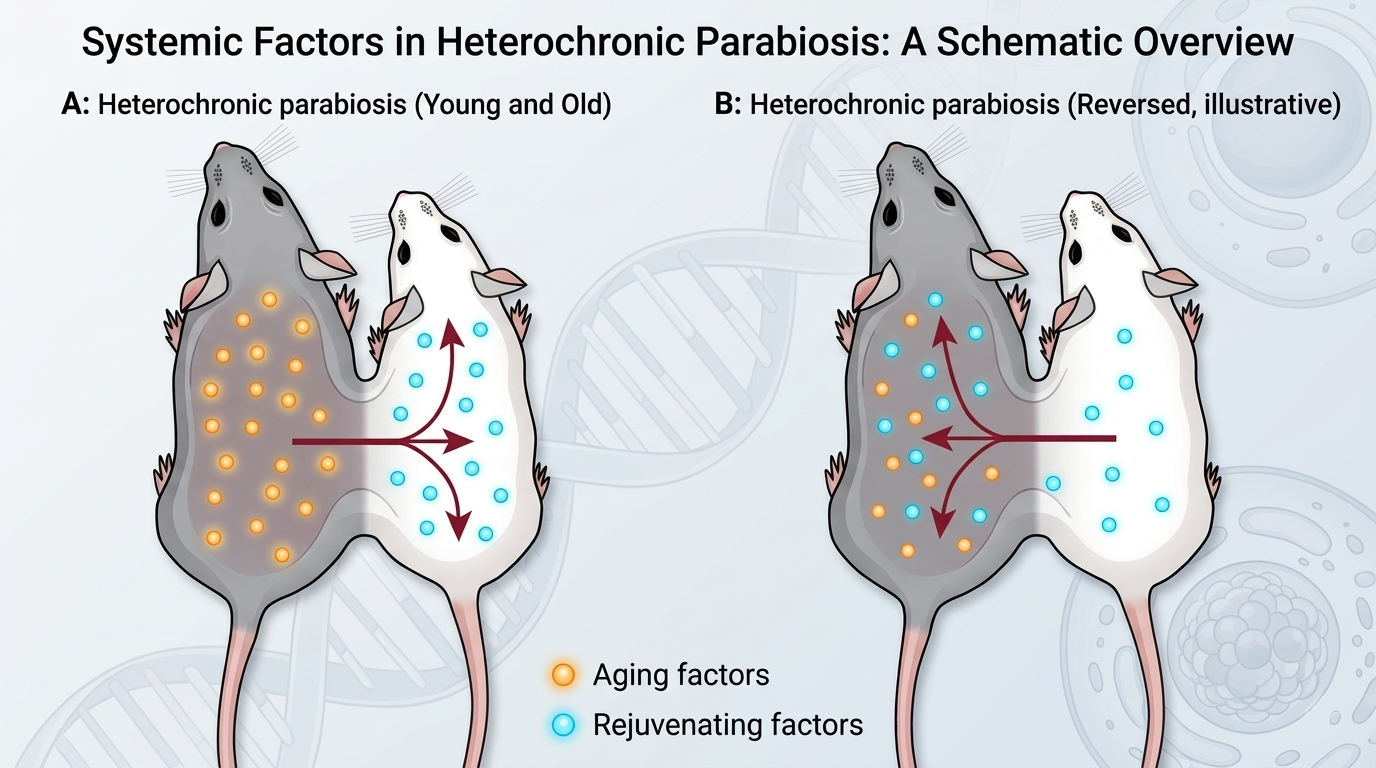
Heterochronic parabiosis is an experimental model in which two organisms of different ages are surgically joined to share a common circulatory system.
This model allows researchers to study how blood-borne factors influence aging, tissue repair, and systemic regeneration.
Key Scientific Insights
Systemic Regulation
Aging is influenced by circulating factors, not just local tissue changes.
Regenerative Signals
Young biological environments contain signals that support tissue repair and function.
Reversible Components
Certain aspects of aging may be modulated through changes in systemic biological conditions.
From Biological Model to Mechanistic Understanding
While parabiosis provides a powerful research model, its clinical application is not practical.
Modern research focuses on identifying and understanding the underlying biological signals responsible for these observed effects.
Translating Science into Technology
Insights from heterochronic parabiosis have contributed to a growing understanding of how biological signaling regulates aging and regeneration.
APAA builds upon this foundation by focusing on the extraction, amplification, and modulation of regenerative signals from autologous plasma.
A New Perspective on Aging
Rather than viewing aging as an irreversible decline, emerging research suggests it is a dynamic and regulated biological process influenced by systemic signaling.
Explore the Technology
Discover how these scientific insights are translated into regenerative solutions through the APAA platform.