
Study Reference
Title
ICH Harmonised Guideline
Guideline For Good Clinical Practice E6(R3)
Statement
This summary is based on the original publication and includes application-oriented discussion for educational and academic reference purposes only. It is not intended as medical advice.
Summary
Introduction: The Credibility Gap in Medical Innovation
In the high-stakes arena of medical advancement, the word “breakthrough” is often met with justifiable skepticism. For decades, the field of regenerative medicine—specifically stem cell therapy—has operated under a shadow of doubt, where the distance between a promising “claim” and a verified “finding” seemed insurmountable. The bridge across this chasm is not just the science itself, but the regulatory framework that governs it.
The GCP 3rd Edition is the regulatory “fortress” that finally allows us to defend Mesenchymal Stem Cell (MSC) data against the most rigorous global scrutiny. By applying these modernized standards to treatments for Lupus Nephritis (SLE/CKD), we are moving beyond anecdotal hope to a new era of clinical precision.
Takeaway 1: The GCP v3 Revolution—From Reactive to Proactive
The transition to Good Clinical Practice (GCP) 3rd Edition is not merely a software update; it is a paradigm shift in data integrity. Older methods relied on manual, paper-based records that necessitated “reactive discovery”—identifying errors only after they had already compromised the study’s timeline.
The new standard establishes a digital-first architecture that “bakes” credibility into the protocol from day one through Proactive Risk-Based Quality Management (RBQM). This 5-step cycle ensures that quality is a design feature, not an afterthought:
- Identify: Pinpoint potential risks to subject safety and data integrity early.
- Assess: Evaluate trial feasibility and risk severity.
- Design: Build protocol parameters and quality controls specifically to mitigate identified risks.
- Monitor: Utilize Electronic Systems (EDC) for continuous monitoring and immutable audit trails.
- Ensure: Execute Quality Assurance (QA) and Quality Control (QC) to validate absolute data accuracy.
“Rigorous regulatory compliance is the foundation that makes breakthrough clinical data precise, credible, and safe.”
Takeaway 2: The Accountability Ecosystem and the Ethical Bedrock
A clinical breakthrough is only as strong as the ecosystem that supports it. At the heart of the GCP framework is the Declaration of Helsinki, the ethical bedrock of all human trials, which ensures that patient rights and safety are prioritized above all else. This “Clinical Accountability Ecosystem” creates a multi-layered shield around the Protected Subject:
- The Sponsor/CRO (Architect & Auditor): They design the protocol and conduct relentless audits to ensure total legal and regulatory compliance.
- The Principal Investigator (The Executor): Directly responsible for the trial’s execution and the health of the subjects, managing the informed consent process.
- The Clinical Research Coordinator (The Facilitator): Manages the “Continuous Data Life Cycle”—from collection and verification to storage and review.
- The Regulatory Body (TFDA/IRB): Acts as the “Protective Umbrella,” conducting field inspections and approving protocols to ensure the highest ethical standards.
Takeaway 3: The “Pure Efficacy” Variable—Removing the Noise
In clinical research, “noise” is the enemy of clarity. To understand the true power of a new intervention, one must isolate its behavior. In “Study 1,” an 87-patient cohort, the researchers employed a daring and sophisticated protocol design: they explicitly excluded the use of steroids or immunosuppressants.
In the context of Lupus Nephritis, where these drugs are standard of care, this exclusion is a bold strategic move. It provides a “high-resolution” view of MSC behavior that is usually blurred by traditional medications. By removing these variables, the trial provided untainted proof that the improvements in renal function were directly attributable to the MSC treatment itself.
Takeaway 4: Consistency is the Ultimate Validator
Statistical consistency across independent cohorts is the “gold standard” of clinical validation. When Study 1 (a rigorous 4-year longitudinal analysis) is compared to Study 2 (a 1-year independent confirmation in China), the concordance of the data is remarkable.
The following table illustrates the striking alignment of these independent results:
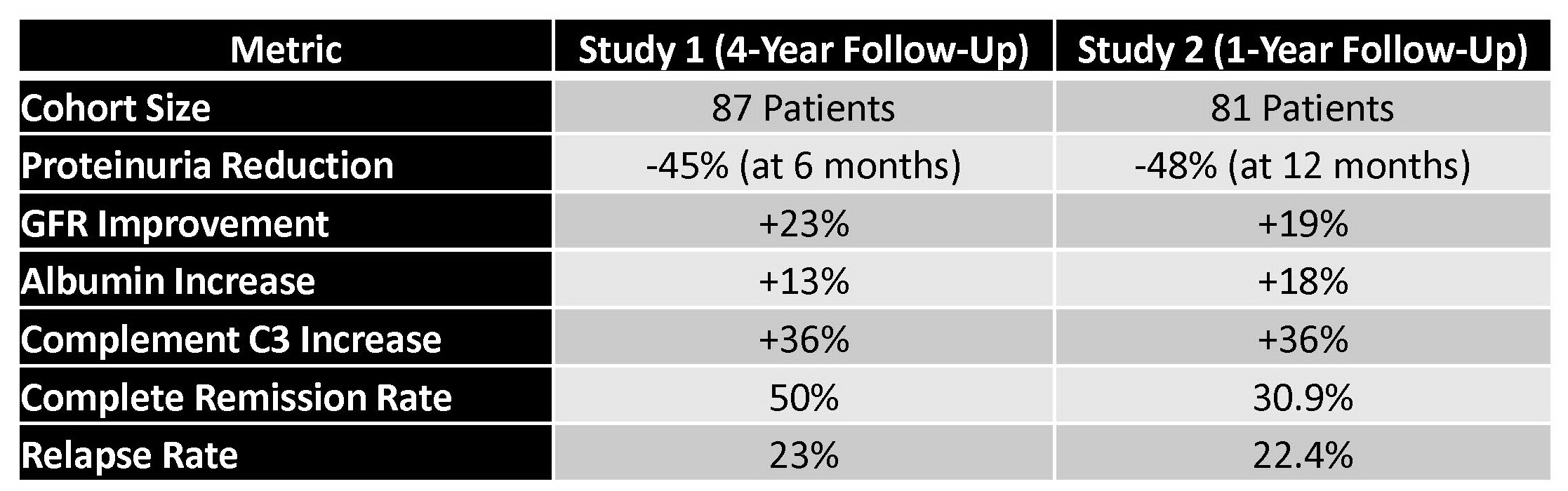
This level of symmetry across different geographies and timeframes validates the biological mechanism of action beyond a reasonable doubt.
Takeaway 5: The Truth About Survival and Safety
Safety is the non-negotiable pillar of clinical excellence. The data highlights an impressive 95% survival rate in the 1-year study (Study 2). However, the true testament to the treatment’s durability is the 94% survival rate over four years in Study 1. Maintaining such a high survival rate over a 48-month trajectory is a significant clinical milestone for any “breakthrough” treatment.
Furthermore, the power of the GCP 3rd Edition framework is most evident in the “Mortality Clarification.” While deaths occurred in both cohorts (5 in Study 1; 4 in Study 2), a rigorous GCP audit and clinical review confirmed that 100% of these mortalities were strictly unrelated to the MSC injections. This level of scrutiny allows us to distinguish between general patient mortality and treatment-specific side effects, confirming that the intervention is both biologically potent and exceptionally safe.
Conclusion: The New Standard for Renal Recovery
The findings are no longer up for debate: MSC treatments for Lupus Nephritis lead to reduced systemic inflammation, restored GFR function, and a verified safety profile. These are not merely observations; they are validated findings captured through the uncompromising standards of GCP 3rd Edition.
Now that we have established a regulatory framework capable of verifying medical “miracles” with absolute precision, we must look forward. What other transformative treatments are waiting to be validated by this level of scientific rigor?
The future of medicine depends not just on the brilliance of the discovery, but on the strength of the framework used to prove it.
Summary Video
Summary File