
Study Reference
Title
Autologous Conditioned Serum
Journal
Physical Medicine and Rehabilitation Clinics of North America (2016)
Statement
This summary is based on the original publication and includes application-oriented discussion for educational and academic reference purposes only. It is not intended as medical advice.
Summary
For millions living with osteoarthritis, the daily reality is a grinding battle within the joints. Traditional medicine has long relied on a standard toolkit: corticosteroid injections to damp down inflammation or Hyaluronic Acid (HA) to provide temporary lubrication. While these offer a reprieve, they are often stop-gap measures that fail to address the underlying biological cascades driving cartilage decay.
Enter Autologous Conditioned Serum (ACS). Though it may seem like a “new” breakthrough in regenerative medicine, this sophisticated German-engineered therapy actually predates the widespread rise of Platelet-Rich Plasma (RPP). Developed in the late 1990s and refined through rigorous clinical standards, ACS represents a shift from simply “concentrating” blood components to “conditioning” them. By leveraging a nuanced understanding of molecular signaling, ACS doesn’t just provide the body with more tools; it tricks the body into creating a customized, high-potency defense against joint degeneration.
The Inflammation Paradox: Mimicking Disease to Create a Cure
The manufacturing of ACS is a masterclass in biological irony. To create a serum that heals, scientists first create an environment that mimics disease. The process begins by drawing approximately 50cc of a patient’s whole blood and placing it into a specialized syringe containing 10 to 20 medical-grade, 3mm glass beads coated in sulfate.
These beads provide a rough surface that mimics a site of injury. For several hours, the blood is incubated with these beads, “tricking” the white blood cells (monocytes and macrophages) into mounting a massive defensive response. Interestingly, this process was originally a 24-hour commitment. However, a pivotal 2004 process change shortened the window to just 6 to 9 hours after research confirmed that levels of the crucial anti-inflammatory protein, IL-1Ra, reached their peak identical concentrations in this shorter timeframe.
“ACS works by producing natural Interleukin-1 receptor antagonists (IL-1Ra). These antagonists are the body’s natural defense, specifically designed to block Interleukin-1 beta—the primary ‘bad’ protein responsible for driving inflammation and destroying joint tissue.”
By the time the incubation is complete, the blood has been transformed. It is then centrifuged to separate the serum, which is now saturated with the body’s own antagonistic proteins, ready to be reinjected into the target joint.
The Growth Factor Explosion: 190x Power
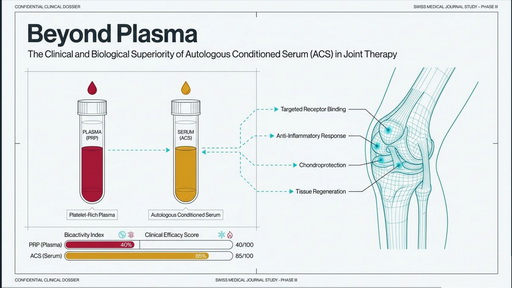
While PRP is famous for concentrating platelets, ACS focuses on the total release of bioactive molecules. Data from clinical analysis shows that the incubation process triggers a massive surge in growth factors compared to the baseline levels found in untreated blood. Unlike other therapies where growth factors remain trapped or are only partially concentrated, the “conditioned” nature of ACS ensures these regenerative proteins are fully available.
The scale of this increase is staggering:
- PDGF-AB: Increased by up to 190x.
- TGF-β: Increased by approximately 84x.
- IGF-1: Increased by 40x, providing a massive boost for cellular repair.
- VEGF (Vascular Endothelial Growth Factor): Jumped from a baseline of 61 to over 500+.
The Serum vs. Plasma Safety Advantage
To the layperson, serum and plasma might sound identical, but in regenerative medicine, the distinction is vital. PRP uses plasma (which requires anticoagulants to stay liquid), whereas ACS uses serum (the liquid left after blood has naturally clotted). This provides three distinct advantages:
- No Anticoagulants: Because serum is used, there is no need for chemical additives like citrate or heparin, which can cause localized irritation in sensitive joint tissues.
- No Clotting Factors: During the ACS process, clotting factors are entirely consumed to form the initial clot. This removes the risk of embolism (vascular blockage) that can occur if concentrated clotting factors are accidentally injected into a vessel.
- Total Release: In PRP, growth factors are “locked” inside platelets for a slow, metered release. In ACS, the 6-to-9-hour incubation ensures that the platelets are fully ruptured, releasing every growth factor into the serum “once and for all” for an immediate biological impact.
Quick Comparison:
- PRP (Plasma): Requires chemical anticoagulants; carries risk of clotting factors; provides slow release.
- ACS (Serum): Purely autologous; no clotting risk; provides immediate, high-potency delivery.
Proven by Horses, Perfected for Humans
The technology behind ACS—often referred to as “Orthokine”—found its first major success in high-stakes equine medicine. It was used to treat “lame” horses suffering from gait issues and limb length discrepancies, providing the preclinical proof of concept and biomechanical data necessary to move into human trials.
In human clinical studies for osteoarthritis, the metrics for ACS are strikingly high. Research tracking over 1,000 cases found that 70% of patients experienced a greater than 50% improvement in pain and function. Crucially, 35% of patients maintained this improvement for 3.5 years.
When researchers compared the “Effect Size” (a statistical measure of clinical potency), ACS significantly outperformed traditional standards:
- ACS: 0.73
- Steroids: <0.50
- Hyaluronic Acid: 0.46
- PRP: 0.40
The “Convenience Trap”—Why You Haven’t Heard of It (Yet)
If ACS is more effective than PRP and safer than steroids, why isn’t it in every clinic? The answer lies in the “convenience trap.”
PRP is a “lunchtime” procedure; a doctor can draw blood, spin it, and inject it within 20 minutes. ACS, by contrast, is “troublesome.” It requires a precise, 6-to-9-hour incubation period in a temperature-controlled environment to allow the molecular signaling and platelet rupture to occur. This timeline requires patients to wait or return the next day, which doesn’t always fit the fast-paced, high-volume model of modern clinics. However, for the patient seeking potency over speed, “not being afraid of trouble” is the prerequisite for superior clinical outcomes.
Conclusion: The Future is Autologous
The evolution of joint therapy is moving away from synthetic chemicals and toward the optimization of our own biology. ACS proves that our blood already contains the “medicine” we need; it simply needs to be conditioned and released correctly.
As we move toward a future of personalized medicine, we must ask: Is the future of healing found in a lab-made drug, or is it hidden within a highly conditioned version of our own blood? The data suggests that when we take the time to listen to the body’s own signals, the results are far more powerful than anything we can create in a vial.
Summary Video
Summary File