
Study Reference
1. Title
Generation of Cancer Stem/Initiating Cells by Cell–Cell Fusion
Journal
International Journal of Molecular Sciences (2022)
Statement
This summary is based on the original publication and includes application-oriented discussion for educational and academic reference purposes only. It is not intended as medical advice.
Summary
In the traditional study of biology, we are taught to view cells as self-contained units—isolated islands defined by rigid membranes that keep “Cell A” strictly separate from “Cell B.” However, the frontier of biotech research is revealing a far more social, fluid, and occasionally chaotic reality. Through phenomena known as Cell Fusion and Tunneling Nanotubes (TNTs), cells frequently shatter these boundaries, merging their contents and sharing their internal hardware in ways that defy our neatest textbooks.
What happens when the line between two distinct cells disappears? It is a question that is currently shifting our understanding of everything from evolutionary adaptation to the existential risks of modern regenerative medicine.
Takeaway 1: Cell Fusion Isn’t a Lab Accident—It’s a Natural “Game of Chance”
Cell fusion is often dismissed as a byproduct of artificial laboratory manipulation, but it is a fundamental, natural occurrence within the human body. Somatic cells, stem cells, and even germ cells possess the inherent capacity to merge under specific environmental stimuli or stressors.
This process isn’t always a strictly programmed biological command. Instead, it is a stochastic process—a biological “game of chance.” When cells find themselves in high-density environments, specific membrane proteins can interleave, causing two separate lipid bilayers to snap together into a single entity.
“Cell fusion is a natural state rather than a deliberate human intervention.”
This inherent probability means that fusion is a constant, quiet background hum in our biology, occurring whenever the “luck” of proximity and cellular stress align.
Takeaway 2: Tunneling Nanotubes (TNTs)—The Microscopic Highways
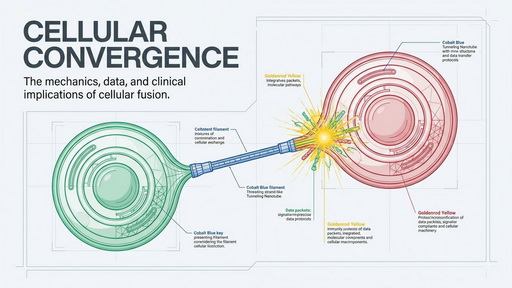
One of the primary mechanisms for this cellular “socializing” is the Tunneling Nanotube (TNT). These are physical protrusions—often referred to as a “Narub”—that bridge the gap between cells. These structures are far more than signaling antennas; they are microscopic highways for the physical transfer of “hardware,” including mitochondria and vesicles.
The physical scale of these interactions is staggering, with fusion occurring at distances of less than 1 nanometer (nm). Current research identifies several distinct docking models:
- Thick vs. Thin TNTs: Varying diameters tailored to the size of the cargo being exchanged.
- Side-to-Side: Cells aligning and merging along their lateral membranes.
- The “Socket” Model: Perhaps the most sophisticated, where one cell creates a protrusion that fits into a targeted “receptor” indentation on the target cell, implying a docking mechanism that is far from random.
This physical exchange allows cells to “rescue” one another by sharing healthy mitochondria, but it also provides a back-door for the spread of pathogens or drug-resistant traits.
Takeaway 3: The Million-Cell Margin of Error
While cell fusion is natural, it remains a low-probability event. However, when we scale these percentages to clinical reality, the “low” numbers become massive. Data from in vitro and in vivo studies highlight a persistent baseline:
- 1% to 2%: Fusion rate in Embryonic Stem Cell (ESC) and Mesenchymal Stem Cell (MSC) co-cultures.
- 0.05% to 0.1%: Fusion rate observed in 14-day in vivo studies.
- 0.18% to 0.3%: Fusion rate in 51-day in vivo studies.
Consider the math: in a typical stem cell therapy involving an injection of 100 million cells, a seemingly negligible 0.1% fusion rate means 100,000 hybrid cells are created inside the patient.
Furthermore, there is a critical biological bottleneck: fusion of the cell body (cytoplasm) does not guarantee fusion of the nuclei. Research suggests that only about 1/10th of fused cells actually undergo nuclear fusion. This explains why the vast majority of these hybrids fail to thrive, while a tiny, persistent minority survives to potentially rewrite the host’s genetic script.
Takeaway 4: The Double-Edged Sword—From “Supercells” to Cancerization
The outcome of a cellular merger is a high-stakes gamble. Roughly 99% of fused cells either stop growing (arrest) or die because their combined genetic load is too unstable. But the remaining 1% can become “supercells” with enhanced survival capabilities, or—more dangerously—undergo “cancerization.”
This is the primary anxiety in stem cell therapy. If a transplanted cell fuses with a host cell, it may gain the ability to differentiate without the usual biological brakes. This mechanism is also a prime suspect in drug resistance; just as bacteria swap plasmids to share antibiotic resistance, fused cells can gain the “hardware” (like efflux pumps) to recognize a drug and spit it out before it can work.
However, we are also learning to weaponize this process. In a promising “pro-fusion” application, researchers are fusing Dendritic Cells (DCs) with Tumor cells. This creates a hybrid cell that presents tumor antigens directly to the immune system, essentially “teaching” the body to recognize and kill cancer.
“The difference between a Stem Cell and a Cancer Stem Cell is that a Stem Cell differentiates under control, while a Cancer Stem Cell differentiates without it.” — An unresolved debate among researchers.
Takeaway 5: Old Viruses, New Tricks—The Roots of Modern Bio-Tech
Modern talk of TNTs and genomic “mashups” might feel like science fiction, but the foundations were laid decades ago. In 1971, researchers were already using the Sendai virus to induce cell fusion. Even the mechanism of drug resistance via TNTs mirrors ancient bacterial tactics, where tubes are used to swap resistance-granting DNA between individual microbes.
The difference today is that we finally have the tools to see what we only suspected in the 70s. 3rd Generation Next-Generation Sequencing (NGS) has changed the game. We now have portable devices—costing roughly $30,000 USD—capable of “long-read” sequencing. This allows us to read entire strands of DNA and map complex DNA methylation patterns, giving us a front-row seat to the genetic recombination that occurs after two cells become one.
Conclusion: A New Lens on Cellular Therapy
Understanding cell fusion and TNTs forces us to abandon the idea of cells as static, predictable components. When we introduce a therapy into the human body, we are placing “hardware” into a dynamic, “lucky,” and unpredictable social network.
This knowledge could revolutionize how we approach antigen presentation and regenerative medicine, but it leaves us with an investigative challenge: How do we harness the power of the “supercell” while silencing the 1% that leads to malignancy? As we move toward a future of precision medicine, we must first learn to master the stochastic chaos of the cellular mashup.
Summary Video
Summary File