
Study Reference
Title
Old plasma dilution reduces human biological age: a clinical study
Journal
GeroScience (2022)
Statement
This summary is based on the original publication and includes application-oriented discussion for educational and academic reference purposes only. It is not intended as medical advice.
Summary
1. Introduction: The Biological Reset Button
The human quest for rejuvenation is as old as history itself, but modern science is shifting the focus from mythical fountains to the very fluids circulating in our veins. In 2022, a groundbreaking clinical trial led by the Arena team suggested that we might not need to find a way to “stop” time—we might just need to dilute it.
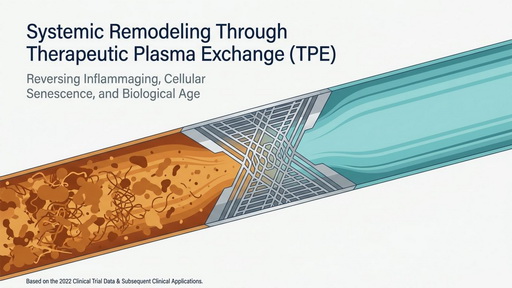
The procedure is known as Therapeutic Plasma Exchange (TPE). While traditionally used to treat critically ill patients by removing harmful antibodies, it is now being reimagined as a “biological reset” for the aging body. The process is elegant in its simplicity: a subject’s old, protein-heavy plasma is gradually removed and replaced with a clean mixture of saline, 5% albumin, and a protective infusion of IVIG. By “washing” the blood of a cohort of older adults (aged 65–75) and comparing them to a younger group (aged 20–29), researchers are discovering that cleaning the “biological pipes” can fundamentally reboot our internal aging clock.
2. Takeaway #1: It’s Not Just Blood—It’s a DNA Repair Kit
In longevity science, we often talk about “zombie cells” and frayed genetic code. The Arena study looked specifically at 8-OHdG—a primary marker for DNA damage—and the p16 protein, a notorious hallmark of cellular senescence. When these markers are high, your body is essentially screaming that its repair systems are overwhelmed.
The results showed a dramatic downward trend in these markers as subjects moved from their baseline (R0) to the final round of treatment (R5). It is important to note, however, that while the trend is promising, the sample size diminished significantly by the end of the study; by R4 and R5, the data often relied on very few participants.
Scientifically, TPE isn’t “re-weaving” your DNA like a microscopic seamstress. Instead, by lowering the systemic load of these damage markers, TPE likely clears the “cellular smog,” allowing the body’s natural repair mechanisms to finally do their jobs. As the researchers noted: “TP is very effective at reducing DNA damage and cell senescence.”
3. Takeaway #2: Remodeling the Immune System (The Myeloid Shift)
One of the most definitive markers of an aging body is the “Myeloid-to-Lymphoid shift.” As we age, our immune system becomes dominated by inflammatory myeloid cells (like monocytes), while the “special forces” of our immune system—the lymphoid cells—begin to dwindle. This is a primary driver of “inflammaging.”
TPE doesn’t just filter the blood; it triggers a systemic remodeling that reverses this ratio. The analysis of Peripheral Blood Mononuclear Cells (PBMCs) revealed a striking “Gain vs. Loss” profile:
- Increases (The Rejuvenation): CD3+ T-cells, Helper T-cells, B-cells, and Natural Killer (NK) cells.
- Decreases (The Inflammation): Myeloid-induced cells and Monocytes.
This isn’t a minor adjustment; it’s an architectural overhaul. By shifting the body back toward a lymphoid-heavy profile, TPE helps restore the immune system’s youthful ability to seek and destroy threats rather than dwelling in a state of chronic, self-destructive inflammation.
4. Takeaway #3: Diluting the “Biological Noise” of Chronic Disease
Think of your blood not as a stagnant pool, but as a crowded room where everyone is screaming. As we age, we accumulate “Biological Noise”—a cocktail of harmful proteins and inflammatory signals known as the SASP (Senescence-Associated Secretory Phenotype). The study identified 72 specific proteins that were 1.75x higher in the 65–75 age group compared to the 20-somethings.
TPE acts as the ultimate “open window” for this crowded room. By physically diluting these “noisy” signals—specifically those moving through the NF-κB pathway and TNF receptor interactions—the procedure replaces stale, signal-heavy air with a fresh start. This dilution was so effective that after just two rounds of treatment (R2), the protein profiles of the older subjects began to mirror those of the young cohort.
5. Takeaway #4: A Shield Against Cancer and Neurodegeneration?
Perhaps the most high-impact discovery involves the reduction of “stubborn” proteins associated with our most feared diseases. TPE didn’t just lower general inflammation; it targeted specific markers for pancreatic, gastric, and ovarian cancers.
Even more impressive was the impact on TDP-43, a protein closely linked to ALS and Frontotemporal Dementia. Unlike many pharmacological interventions that struggle to move the needle on neurodegenerative markers, TPE showed an aggressive and rapid reduction. The transcript highlights the sheer speed of this intervention: “TPE can very effectively reduce the level of TDP-43 protein in a very short period.” By clearing these “clogging” proteins from the serum, TPE may fundamentally alter the systemic environment that allows cancer and brain decay to take root.
6. The “Aspirin” of the Future? A Discussion on Feasibility
During the study’s internal discussions, a cynical but brilliant question was raised: “If these treatments are just about reducing inflammatory responses, you wouldn’t need these procedures—you could just take an aspirin a day for one dollar.”
The counter-argument is the crux of why TPE is a frontier technology. While a one-dollar aspirin blocks a specific pathway, TPE provides comprehensive systemic dilution. It simultaneously removes LPS (bacterial toxins), inflammatory proteins, and “biological noise” that no single pill can target.
However, there is a catch: the “Rebound Effect.” The data suggests that markers like TDP-43 can begin to climb back to baseline in as little as three days to two weeks. This makes TPE a frequency-dependent intervention. To maintain these youthful signatures, the procedure must be performed aggressively—often twice a week during active phases—to prevent the “noise” from returning.
7. Conclusion: The New Timeline of Rejuvenation
We are entering an era where aging is viewed as a manageable condition rather than an inevitable decline. Newer research from 2025, conducted by the Buck Institute, has taken the Arena team’s foundation a step further, suggesting that TPE can reduce biological age by approximately 2.6 years.
While the procedure is currently intensive and clinical, the evidence—from DNA repair and immune remodeling to the clearing of neurodegenerative proteins—is hard to ignore. If the “fountain of youth” is simply a matter of diluting the accumulated noise of our past, how soon will “blood cleaning” move from the clinical trial to your annual check-up?
Summary Video
Summary File