
Study Reference
1. Title
Life-long oligodendrocyte development and plasticity
Journal
Seminars in Cell & Developmental Biology (2021)
DOI
10.1016/j.semcdb.2021.02.004
2. Title
Platelet-derived growth factor-AA mediates oligodendrocyte lineage differentiation through activation of extracellular signal-regulated kinase signaling pathway
Journal
Neuroscience (2008)
DOI
10.1016/j.neuroscience.2007.10.050
3. Title
Establishment of an Immortalized Canine Hippocampal Neural Stem Cell Line via SV40LT Retroviral Transduction
Journal
Cells (2026)
4. Title
Immortalization of neuronal progenitors using SV40 large T antigen and differentiation towards dopaminergic neurons
Journal
Journal of Cellular and Molecular Medicine (2012)
Statement
This summary is based on the original publication and includes application-oriented discussion for educational and academic reference purposes only. It is not intended as medical advice.
Summary
1. Introduction: The Body as a Dynamic Construction Site
We are far more than the sum of our static parts. In the eyes of a regenerative scientist, the human body is a high-tech, 24-hour construction site where repair is a constant, shifting negotiation. At any given moment, your cells are “reading” their environment, communicating across vast biological distances, and deciding whether to rebuild or retreat.
The central mystery of our field has never been if the body can heal, but how it knows what to do. Recent breakthroughs in understanding specialized cells like OPCs and Podocytes are forcing us to abandon the old “replacement part” model of medicine. Instead, we are uncovering the hidden “instruction manual” of recovery—the biological work orders that determine whether a wound closes or a filter fails.
2. The 90-Day Window: The Critical Lifecycle of OPCs
In the architecture of the mind, the clock is an unforgiving builder. To understand neuroprotection, we must look at Oligodendrocyte Progenitor Cells (OPCs), the precursors to the cells that insulate our nervous system.
Our data, largely derived from foundational mouse models, reveals a strict developmental timeline. In these models, OPCs begin their proliferation as early as 14 days into gestation. However, the truly critical “active growth” phase occurs from birth through the first three months—a 90-day window where the brain is most receptive to forming the myelin sheath.
The master signal in this process is PDGFA, a growth factor that acts as the primary chemical trigger for cell differentiation. Without this signal during the peak window, the “water jacket” of the nerve cell remains incomplete.
“OPC [is] mainly in the myelin sheath… protecting the nerve cell’s water jacket.”
This insight tells us that timing isn’t just a factor in neurological repair; it is the entire game.
3. The Kidney’s Elite Gatekeepers: Why Podocytes Don’t Regrow
Deep within the kidney’s Bowman’s capsule—a structure measuring between 0.1cm and 0.2mm (200μm) in diameter—resides an elite class of gatekeepers: Podocytes. These cells form a sophisticated filtration barrier, using hydrostatic pressure to permit small molecules to pass into the urine while locking essential proteins like albumin within the blood.
Fact Check: The filtration size limit for this barrier is incredibly precise, typically between 70K to 100K Daltons.
The tragedy of Chronic Kidney Disease (CKD) lies in a counter-intuitive biological reality: Podocytes are highly differentiated and do not regenerate. Furthermore, we’ve discovered that Podocytes possess “APC” (Antigen Presenting Cell) functions. They don’t just filter; they negotiate with the immune system. When these gatekeepers die, the filter breaks permanently, and the immune system loses its local moderator. This is why “like must repair like”—to fix a kidney, you cannot simply lower inflammation; you must address the loss of these non-renewable specialists.
4. The MSC Paradox: Why “Vanishing” Cells Still Heal
One of the most profound “aha!” moments in modern biotech involves Mesenchymal Stem Cells (MSCs). For years, we were puzzled: clinical trials showed MSCs were effective, yet their survival rate post-injection is abysmal—often less than 1% after just 24 hours.
If the “workers” die immediately, how does the building get fixed? We now understand this as the “Trigger Effect.” MSCs are highly expressive models; they don’t need to live long because they aren’t the laborers—they are the spark. They force the body’s local environment to transition to the next stage of healing before they vanish.
“You only need to turn the car key once; the car can then run for a long time until you turn it off.”
The MSC is the key. It starts the engine of the body’s latent repair mechanisms and then exits the scene
5. The “Foreman” Principle: Why Organ-Specific Signals Matter
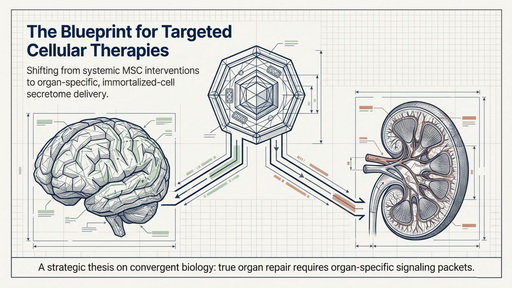
While generalist cells like MSCs are excellent for systemic immune regulation, they often lack the “local knowledge” required for specific organ repair. To truly restore a kidney or a liver, a “general laborer” isn’t enough. You need the “Foreman Principle.”
An organ-specific project manager (the secretome or exosomes derived from that specific organ’s cells) carries the unique architectural plans for that site. If your kidney is failing, a “Kidney Foreman” knows which proteins to build and which filters to clear. This shift from “generalist” stem cells to “specialist” signals is the next frontier. We are moving away from the “cell” as the therapy and toward the “instruction” as the cure.
6. The “Delivery Address” Problem: Precision Over Volume
The greatest hurdle in regenerative medicine is a logistical one. Imagine 300 highly skilled Indonesian workers arriving at an airport. They are ready to work, but if they stay at the airport, the house never gets built.
This is the failure of “systemic infusion.” When we let cells float aimlessly in the blood, they often get stuck in the lungs or circulate without purpose. They are in the right city (the body), but they don’t have a “Taipei City address” for the specific job site (the cortex of the kidney or a spinal injury). The future of medicine isn’t about increasing the volume of cells; it’s about “targeted delivery”—using exosomes and localized injections to ensure the package reaches the correct front door.
7. Conclusion: From Live Cells to Information Therapy
We are witnessing a paradigm shift from “Cell Therapy” to “Information Therapy.” Think of the exosome as a LINE voice note sent by a Foreman to a confused worker. The local cell might not know how to fix a complex protein leak, but it can listen to the 1-2-3 instructions in that “voice note” and execute the repair perfectly.
We no longer need to provide the labor; we need to provide the work orders. The body is already the world’s most advanced repair shop—it has the tools and the materials. It is simply waiting for the right message to be delivered to the right address.
If your body is already the world’s most advanced repair shop, are we finally learning how to write the work orders?
Summary Video
Summary File