
Summary
1. Introduction: The Invisible Lab Work Saving Lives
In modern diagnostics, the ability to find a single viral protein or a specific hormone within a complex sea of blood is the difference between early intervention and a missed diagnosis. This critical precision is powered by ELISA, or Enzyme-Linked Immunosorbent Assay, a biochemical technique that serves as a molecular matchmaker.
By utilizing the high specificity of antibodies and the catalytic power of enzymes, ELISA identifies and quantifies target proteins with remarkable accuracy. While it has become an industrial gold standard, the underlying mechanics—ranging from evolutionary biology to clever chemical amplification—reveal why this technology remains so sensitive and reliable.
2. The “Tail” That Tells the Tale: The Hidden Power of the FC Region
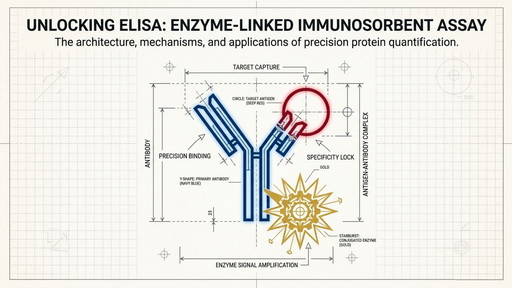
At the heart of ELISA is the IgG antibody, a Y-shaped structure composed of heavy and light chains held together by covalent disulfide (DF) bonds. While the FAB (antigen-binding) regions at the tips of the “Y” grab the target, the base of the antibody—the FC (constant) region—manages the biological “effector functions.”
This FC region interacts with neonatal-type receptors (FcRn) to mediate recycling, effectively determining the antibody’s half-life in the body. Beyond its biological role, the FC region provides a strategic economic advantage in the lab. Because the FC region is consistent within a species, secondary antibodies can be mass-produced cheaply to recognize them, unlike the expensive, specialized primary antibodies required for specific targets.
“In different species, the FC region is very, very consistent within the same type, but very different between species… this decides how we use a second antibody to recognize it.”
3. The Evolution of “Sugar Coating”: Why the Expression System Matters
When producing proteins for these assays, the choice of a recombinant protein expression system is a decisive factor in the assay’s success. This is due to glycosylation, a process often described as “sugar coating,” which occurs on the FC region and affects the protein’s structural maturity.
The source highlights a surprising evolutionary gap: proteins grown in primitive systems like E. coli lack the sophisticated glycosylation found in animal cells. Because E. coli is evolutionarily immature, the resulting recombinant proteins may differ significantly from the original biological targets, potentially compromising the accuracy of the detection.
4. The “Volume Knob” Effect: How Enzymes Amplify Tiny Signals
The genius of ELISA lies in its ability to amplify a microscopic binding event into a measurable signal using a specific enzymatic reaction. Horseradish Peroxidase (HRP) acts as a volume knob; as it reacts with its substrates, the signal grows stronger over time, allowing for the detection of very low concentrations.
To ensure industrial-grade precision, researchers measure the resulting Optical Density (OD) to create a standard curve. A reliable assay typically requires a linear regression with an R-squared value greater than 0.99.
The HRP/TMB Reaction Sequence:
- Initiation: HRP enzyme reacts with TMB substrate and Hydrogen Peroxide (H2O2) simultaneously.
- Color Shift: The previously colorless solution transforms into a vibrant blue.
- Termination: A “stop solution” of sulfuric acid is added to halt the enzyme.
- Final Result: The solution turns yellow, ready for precise optical measurement.
5. The “Sandwich” Strategy: Why Two Antibodies Are Better Than One
While several ELISA formats exist, the “Sandwich” method is the pinnacle of clinical specificity. It uses a capture antibody fixed to the plate and a primary antibody to “sandwich” the target protein from both sides. For this to work, the antibodies must target different epitopes (binding sites) so they do not compete for the same space.
The difference in sensitivity between methods is quantifiable and profound. While a standard Indirect ELISA has a Limit of Detection (LOD) range of 0.1–1 ng/mL, the Sandwich ELISA can detect targets as low as 1–10 pg/mL, making it vastly superior for early-stage disease detection.
6. The ABC System: Breaking the Limits of Detection
When a target protein concentration is so low it falls below the standard LOD, scientists employ the ABC (Avidin-Biotin Complex) system. This method utilizes the high-affinity bond between streptavidin and biotin. Although one streptavidin molecule can theoretically bind four biotins (a 1:4 ratio), the actual signal is typically amplified 3x because one binding site is occupied by the biotinylated secondary antibody.
For even more extreme sensitivity, researchers move beyond color-changing substrates to chemoluminescence. By producing light rather than a color change, these assays push detection limits even further, though they require specialized “illuminator” equipment to capture the faint molecular glow.
7. Conclusion: The Future of Precision Detection
From its origins in the lab to its current status as a scalable industrial standard in 96-well and 384-well plates, ELISA continues to be the bedrock of protein analysis. Its reliability across various samples—from serum to cell mediums—ensures its place in the future of biotech.
As our ability to amplify these molecular signals grows, we must ask: As our ability to amplify molecular signals grows, what previously “invisible” markers of health and disease will we be able to catch before symptoms even appear?
Summary Video
Summary File