
Study Reference
Title
Effects of spray drying and freeze drying on the protein profile of whey protein concentrate
Journal
Journal of Food Science (2024)
Statement
This summary is based on the original publication and includes application-oriented discussion for educational and academic reference purposes only. It is not intended as medical advice.
Summary
Beyond the Deep Freeze: 5 Surprising Lessons from the Science of Lyophilization
In the world of biotechnology, innovation is often as fragile as the samples it produces. Whether we are working with delicate proteins like Lactate Dehydrogenase (LDH) or cutting-edge extracellular vesicles (EVs), the challenge remains the same: how do we keep these biological entities functional once they leave the high-security environment of a -80 ℃ lab freezer?
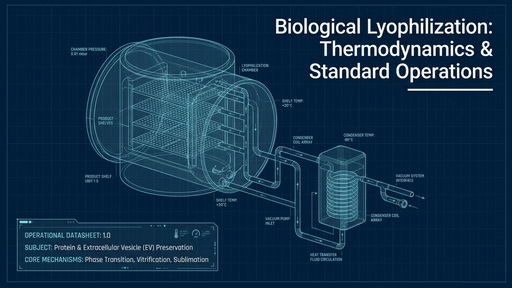
The answer is lyophilization—a process frequently misunderstood as “simple drying.” In reality, it is a sophisticated masterclass in thermodynamics. As a biotechnologist, I see it as a delicate dance between pressure and temperature, where the “devil in the details” can be found in the V-shaped notches of a vial stopper or the specific curve of a vacuum pump’s performance. By mastering the hidden physics of phase changes, we can “pause” molecular motion, turning volatile liquids into stable, long-lasting powders.
1. The Magic of the Triple Point
To master lyophilization, one must first respect the “triface of water.” We typically observe water through its standard transitions: solid, liquid, and gas. Traditional heat-drying moves water from a liquid to a gas, but this phase change often subjects sensitive proteins to mechanical stresses and heat-induced denaturation.
Freeze-drying utilizes a precise shortcut: Sublimation. By manipulating the environment to reach the Triple Point—specifically 0.01 ℃ and 0.612 kPa—water can exist in all three states simultaneously. By dropping the pressure below this threshold, we bypass the liquid phase entirely, allowing ice to transform directly into vapor. This transition is the ultimate safeguard for structural integrity, preventing the chemical reactions and unfolding that occur when proteins remain in a liquid environment during the drying process.
2. Fast Freezing vs. Slow Freezing: The Crystal Paradox
One of the most counter-intuitive lessons in the lab is that “faster is not always better.” While we often flash-freeze samples in liquid nitrogen to save time, the cooling rate profoundly dictates the final residual activity of the protein.
When comparing air-mediated cooling (slow, at \sim 0.2 ℃/min to liquid nitrogen (fast, at 70 ℃/min, we encounter the “Goldilocks” dilemma of ice crystals. Fast freezing creates a massive population of tiny ice nuclei. As these crystals form, they exclude the proteins and solutes into what we call the “unfrozen fraction” or “liquid veins.” In these narrow veins, the solute concentration becomes so high that the protein is forced to unfold and aggregate.
Expert Observation: In experiments with the LDH model protein, we find that without a Cryoprotective Agent (CPA), slow freezing actually preserves more activity than rapid freezing. Fast freezing without protection leads to massive aggregation because the protein cannot survive the extreme concentration shifts within those tiny liquid spaces.
3. Sugars as Molecular Body Doubles
If the goal is to remove water, we must provide the protein with a surrogate to maintain its shape. This is the essence of “Water Replacement Therapy.” We utilize non-penetrating CPAs—specifically sugars like Trehalose and Sucrose—to achieve a state of Vitrification.
Vitrification turns the solution into a “glassy state” rather than a jagged crystalline one. The secret lies in the hydroxyl (-OH) groups of the sugar molecules, which physically step in to form hydrogen bonds with the protein. The sugar essentially “tricks” the protein into thinking it is still hydrated.
- The T_g Factor: Trehalose and Sucrose are preferred because they have a high Glass Transition Temperature (T_g). If the storage temperature remains below T_g, the “glass” remains rigid and the protein stays “immortal.”
- The Buffer Trap: Selection of buffers is equally vital. Buffers like Phosphate can crystallize during freezing, leading to a catastrophic shift (usually a drop) in pH that can denature the sample before the vacuum even starts.
- Avoid Mannitol: While popular, Mannitol tends to crystallize under low pressure, which can destabilize the protein cake.
4. The Two-Stage Dry: Sublimation vs. Desorption
Lyophilization is a marathon consisting of two distinct stages of water removal. This is where the specialized “V-shaped” or notched vial stoppers come into play; they are designed to sit partially open, allowing vapor to escape during the cycle before being mechanically pressed down to seal the vial under vacuum.
- Primary Drying: This stage removes “crystal water” (free ice). Under high vacuum and low temperatures, the ice crystals sublimate and are pulled toward the condenser.
- Secondary Drying: Even after the ice crystals are gone, “unfrozen water” remains chemically bound to the protein. To remove this, we perform a slow ramp-up in temperature—often up to 25 ℃. This provides the energy needed for desorption, breaking the strong molecular bonds of the bound water to ensure the final “cake” is stable for long-term storage.
5. The Vacuum Pump’s Silent Enemy
The vacuum pump is the heart of the system, and its pulse is measured by the vacuum pressure curve. However, its silent enemy is water vapor. If the Condenser (Trap)—which must stay between -40 ℃ and -60 ℃—fails to capture the vapor, it enters the pump.
When water vapor mixes with vacuum oil, it causes emulsification. You will know it when you see it: the oil becomes milky or turbid. Emulsified oil loses its heat exchange capabilities, causing pump temperatures to spike and the vacuum to fail.
Pro-Tip: Senior Tech Maintenance Checklist
- The Gas Ballast: Always open the gas ballast for 30–60 minutes after a cycle to purge remaining moisture from the pump oil.
- 304 Stainless Steel: Ensure your chamber and internal components are 304-grade stainless steel to prevent corrosion from residual moisture.
- The Gasket Warning: Never use high-concentration alcohol (>45%) to clean silicone or rubber O-rings/gaskets; it will degrade the material and cause micro-leaks that ruin your vacuum curve.
- Visual Check: If the oil is anything but clear, change it immediately. A “noisy” pump is often an emulsified pump.
Conclusion: The Future of Stabilized Science
By mastering these variables—the precision of the triple point, the paradoxical cooling rates of ice, and the vitrification of sugars—we do more than dry a sample; we effectively “pause” the biological clock. We turn volatile liquids into stable powders that can be shipped globally without the need for an unbroken cold chain.
As we refine these techniques, we are forced to look toward the horizon: If we can successfully shield a delicate protein or extracellular vesicle from the ravages of time for years, what other complex biological systems—perhaps even entire cells or tissues—could we eventually stabilize in a glassy state, waiting to be “awakened” by the simple addition of water?
Summary Video
Summary File