
Study Reference
Title
Organ aging signatures in the plasma proteome track health and disease
Journal
Nature (2023)
Statement
This summary is based on the original publication and includes application-oriented discussion for educational and academic reference purposes only. It is not intended as medical advice.
Summary
Your driver’s license is a liar. It suggests you have a single age, a chronological milestone that dictates your health, your insurance premiums, and your mortality. But biological reality is far messier. New research is proving that your body isn’t a single unit; it’s a collection of 11 distinct, desynchronized biological clocks. While you might be 40 on paper, your heart could be performing like a 55-year-old’s, while your kidneys remain as resilient as a college athlete’s.
This isn’t science fiction; it’s the result of a landmark 2023 study published in Nature. By training machine learning models on a massive cohort of 1,398 healthy control subjects and validating them against diverse datasets from Stanford and the Alzheimer’s Disease Research Center (ADRC), scientists have unlocked a high-definition “readout” of organ-specific aging. We are entering the era of the “virtual biopsy,” where a single blood draw can pinpoint exactly which part of your internal machinery is failing long before symptoms appear.
The Myth of the Single Biological Score
Traditional medicine—and even modern “longevity” startups—often rely on a “single score” for biological age. Whether it’s an epigenetic clock or a fitness-based metric, these single numbers are useful but inherently limited. They provide a statistical average that masks the dangerous outliers.
The core discovery of recent proteomic modeling is that aging is not a uniform march toward the end. Different tissues and organs age at vastly different rates. When you see a single biological age, you are looking at a composite that hides the “weak link” in your chain. By breaking the body down into individual organ models, we can finally identify which specific system is accelerating toward the finish line and which is maintaining its youth.
The Logic of the Virtual Biopsy: The 4x Protein Threshold
How do we peer inside a living brain or a beating heart without a scalpel? The answer lies in the “plasma proteome.” Every organ in your body expresses specific genes and proteins that eventually leak into the bloodstream.
To map these, researchers identified proteins that were expressed four times higher in one specific organ compared to all others. These “organ-specific” proteins act as biological messengers, carrying the molecular signature of their source. As the source context notes:
“Blood is the carrier of everything… all organs express genes or proteins and release them into the blood. So, the blood carries information from all organs.”
By isolating these 4x-threshold proteins and running them through a computer model, we can perform what is essentially a virtual biopsy. We no longer need to wait for an organ to fail to measure its “mileage”; we just need to listen to the data it’s already broadcasting.
The “HGap”: Mapping the Danger Zone
The primary metric for this new science is the “HGap” (Health Gap)—the delta between an organ’s predicted biological age and your actual chronological age.
When researchers mapped these HGaps on an “Aging Curve,” they found that the danger isn’t just a general trend. If an organ’s age falls 1 to 2 standard deviations (SD) away from the norm, the risk of disease skyrockets. However, the sensitivity is even more acute: for certain phenotypes, even a 0.5 SD shift shows a significant median change in health status, signaling a pre-clinical transition toward pathology.
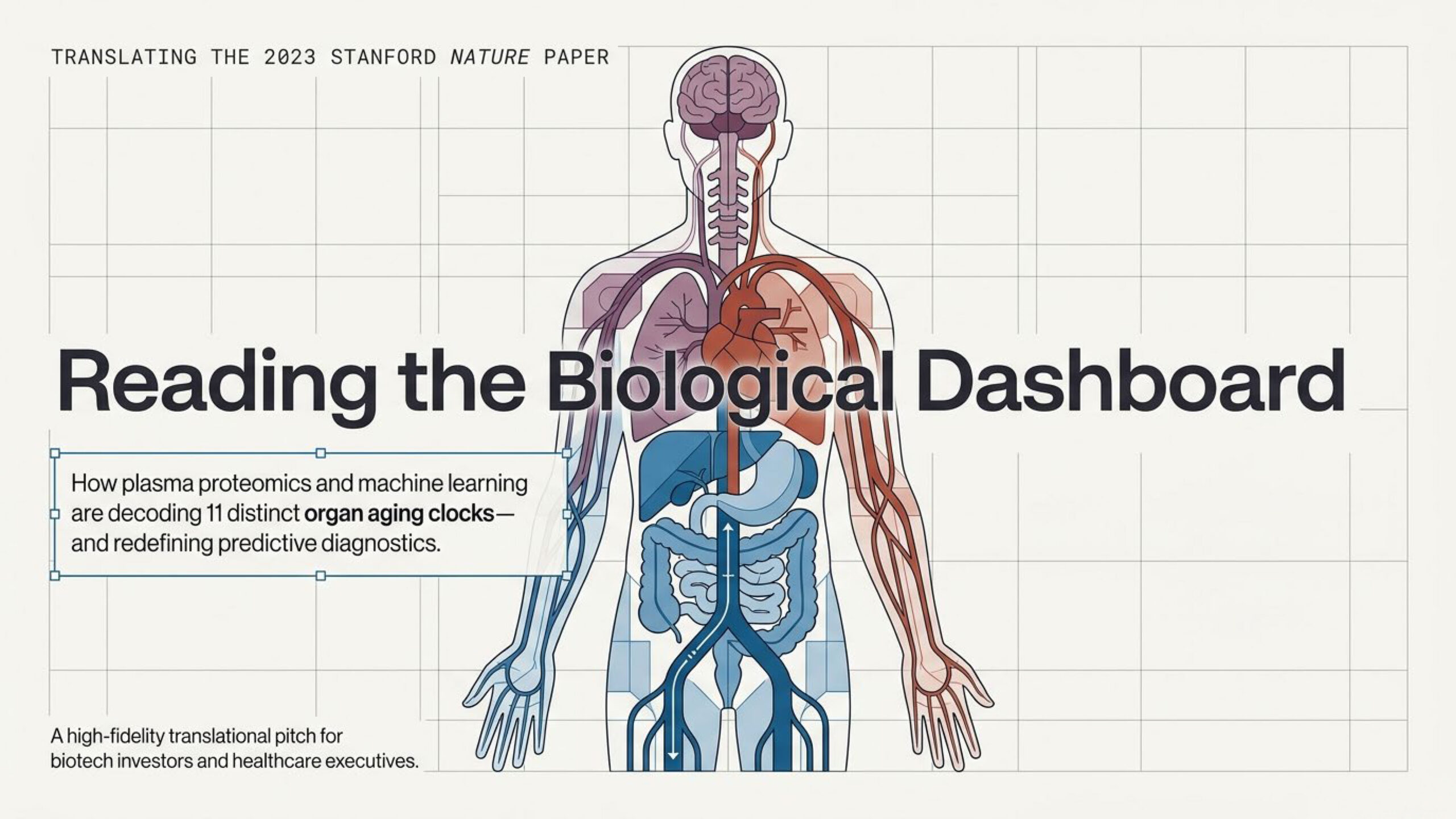
The research established specific models for 11 organs and systems, grouped by their functional impact:
- Organ-Specific: Brain, Kidney, Liver, Lung, Intestine, Pancreas.
- Cardiovascular: Heart, Artery, Muscle.
- Functional/Systemic: Fat (Adipose), Immune System.
The Alzheimer’s Triad: Predicting the Fall Five Years Early
The most explosive finding involves the vascular-neural intersection. For decades, we’ve looked for Alzheimer’s markers like plasma tau proteins. But the organ-specific clock model found something more accurate: cognitive decline is rarely just a brain problem.
By analyzing the “triad” of the Brain, Artery, and Heart (and to a lesser extent, the Pancreas), researchers can predict cognitive decline with startling precision. The “Artery HGap” is particularly critical; it signals vascular fibrosis and the degradation of the blood-brain barrier. When this barrier fails, neural degradation follows.
Crucially, this HGap model outperformed current gold-standard plasma tau markers in predicting future decline. The predictive window is a life-altering five years:
“If both indicators [Brain and Artery HGap] show a significant difference… you have an 80% chance of developing Alzheimer’s within five years.”
Disrupting the $4.5 Trillion Healthcare Machine
Currently, the global healthcare industry is built on “late-stage management”—treating diseases after they’ve already compromised the patient’s quality of life. This proteomic science is a direct disruptor to that $4.5 trillion model.
The original study utilized nearly 5,000 proteins, an expensive and labor-intensive process. However, the science is being “distilled” into a practical 100-point test. By identifying the ~100 most critical markers for each organ, this frontier science is becoming a commercially viable diagnostic. We are moving from high-cost laboratory research to a routine, affordable check-up tool that allows for “risk-based prevention.”
Aging is Not a Monolith: Systemic vs. Outlier Aging
The data reveals two distinct patterns of decline: Systemic Aging and Outlier Aging.
- Systemic Aging: All 11 clocks tick in unison. These individuals age uniformly and generally stay healthy longer.
- Outlier Aging: A person may appear fit, but one organ—an “extreme outlier”—is racing ahead of the others.
These outliers are the silent drivers of specific pathologies. A healthy-looking 50-year-old with a “Liver HGap” of +15 years is a patient in waiting, even if their blood work looks normal today. Identifying these “clocks out of sync” allows us to target the specific driver of a disease before it becomes systemic.
A New Map for Longevity
We are witnessing a paradigm shift. We no longer have to wait for the check-engine light to blink. By using the plasma proteome as a roadmap, we can treat the clock instead of the disease.
If you knew today that your arteries were aging 10 years faster than your heart, would you wait for a stroke to change your life? The HGap offers us the ultimate gift in medicine: time. We are finally moving toward a future where we don’t just add years to our lives, but we ensure that every organ is young enough to enjoy them.
Summary Video
Summary File