
Study Reference
1. Title
Structure of the thrombopoietin-MPL receptor complex is a blueprint for biasing hematopoiesis
Journal
Cell (2023)
2. Title
The thrombopoietin receptor, c-Mpl, is a selective surface marker for human hematopoietic stem cells
Journal
Journal of Translational Medicine (2006)
3. Title
Thrombopoietin levels in patients with disorders of platelet production: Diagnostic potential and utility in predicting response to TPO Receptor agonists
Journal
American Journal of Hematology (2013)
4. Title
Hepatic thrombopoietin is required for bone marrow hematopoietic stem cell maintenance
Journal
Science (2018)
Statement
This summary is based on the original publication and includes application-oriented discussion for educational and academic reference purposes only. It is not intended as medical advice.
Summary
1. Introduction: The Statistical Ghost in Your Bloodstream
SCALE: SYSTEMIC TO MOLECULAR
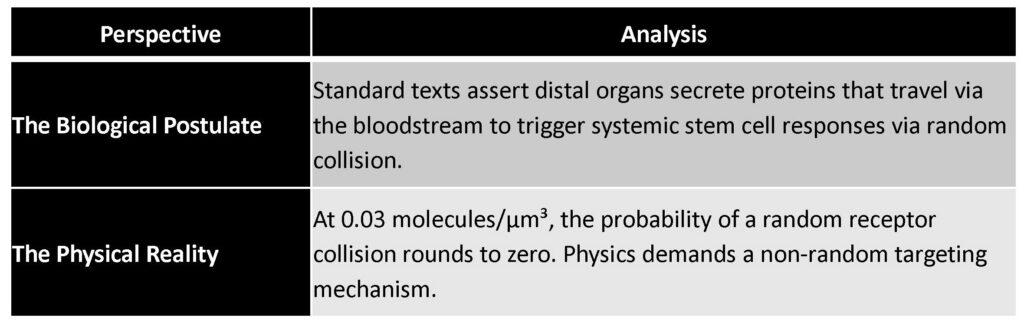
In standard biological curricula, distal endocrine signaling is often presented as a “random mixing” problem. The model suggests that organs like the liver secrete proteins into the vast, turbulent volume of the human circulatory system, where they drift stochastically until they happen to collide with a target receptor.
However, from a systems biology perspective, this model contains a hidden mathematical impossibility. This is the Picogram Paradox: the reality that critical physiological signals exist at concentrations so low (<100 pg/ml) they should, statistically, never find their targets. Nature does not rely on the “luck” of random receptor collisions to drive macro-physiology. Instead, it utilizes a highly engineered Biophysical Funnel—a deterministic sequence of physics, chemistry, and biology—to ensure that a nearly non-existent signal results in a systemic response.
2. The Mathematical Impossibility of “Random Chance”
SCALE: MICRO (10-MICROMETER CAPILLARY)
To ground this paradox in physical reality, we must look at the density of these molecules. When signaling proteins operate in the picogram range, the molecular scarcity is extreme.
Technical Specification: The Math of Scarcity
- Volume: 10⁻¹⁵ cubic meters
- Molecular Weight: 20kD
- Avogadro’s Constant: 6.02 x 10²³
- Calculated Density: 0.03 molecules per cubic micrometer
In a standard 100µm segment of a capillary—the primary site of signal exchange—there are roughly only three target molecules floating in a rushing river of blood.
3. Stage 1: Spatial Concentration (Physics)
SCALE: MICRO (VESSEL FLOW)
The first stage of the funnel utilizes Laminar Flow Hemodynamics to bypass the “rushing river” problem. The vasculature does not treat all blood components as a uniform mixture; it passively sorts molecules by mass.
In any given vessel, there is a “Fast Flow Zone” in the center and “Marginal Slow Zones” near the capillary walls. Much like large fish seeking the center of a fast current, heavy masses (such as red blood cells) stay in the central high-velocity stream. Meanwhile, smaller proteins (approx. 20kD) are physically marginalized to the slow-moving edges. This passive sorting dramatically increases the local concentration of rare molecules specifically where they are needed: in the “slow lane” directly adjacent to target tissues.
4. Electrostatic Gradients as “Molecular Velcro”
SCALE: NANO (CELL SURFACE INTERFACE)
As hemodynamics push these rare proteins toward the vessel wall, the funnel transitions from fluid mechanics to electrostatics. The capillary interface is not a passive boundary; it is a charged field.
“Electrostatic gradients act as a velcro net to capture marginalized proteins, halting their momentum and positioning them directly adjacent to cellular receptors.”
Free-floating soluble proteins are snagged by opposing electrostatic charges on the capillary wall. This interaction solves the momentum problem, arresting the protein’s movement and ensuring it remains within the high-affinity niche localization zone rather than being swept away by the systemic flow.
5. Stage 2: Structural Stabilization (Chemistry)
SCALE: NANO (MOLECULAR BINDING)
Once a molecule is localized, the funnel employs Structural Stabilization to guarantee signal transduction. This is where “background signaling” is differentiated from “precision distal signaling.”
Consider the FGF2 Pathway: this represents background signaling and requires no co-factor. In contrast, precision distal signals like FGF19/21 are so rare they require a mechanical “lock” to function. These molecules rely on a specific co-receptor called Beta-Klotho (BKL). The BKL co-receptor caughts, twists, and physically bridges the isolated FGF molecule to the FGFR complex.
Data Callout: Technical analysis shows that knocking out BKL mRNA abolishes the signal entirely, regardless of FGF dosage. Without this structural stabilizer to “bridge” the gap, the rare picogram signal is lost. This is not simple chemistry; it is precision receptor mechanics acting as a mechanical bridge.
6. Stage 3: Intracellular Ignition (Biology)
SCALE: MICRO (INTRACELLULAR)
The final stage of the funnel is the Intracellular Ignition. Once the rare protein is captured and stabilized, it acts as an “Ignition Key” for a pre-loaded system.
The protein itself does not provide the energy for the cellular response; it merely releases the engineered constraints of the local biological network. A single stabilized binding event triggers a massive, exponential intracellular cascade. This signal transduction amplifies the input by orders of magnitude at each tier, resulting in a >10,000x (10⁴) amplification.
7. Absolute Dependency, Not Redundancy
SCALE: SYSTEMIC (ORGAN NETWORK)
This distal signaling architecture is a physiological requirement, not a backup system. This is best illustrated by the relationship between the Liver (Source) and the Bone Marrow (Target) via Thrombopoietin (TPO).
TPO is an exceptionally low-background signal (~39 pg/ml) that targets the MPL receptor. Crucially, the MPL receptor is expressed on strictly ~10% of Stage 1-4 stem cells, making the target even rarer than the signal.
When the distal source (the liver) is severed, the system collapses despite the presence of local bone marrow TPO:
- Endogenous local TPO: Maintains basic cellularity but is insufficient for activation.
- Distal liver-derived TPO: The only signal capable of triggering Hematopoietic Stem Cell (HSC) activation frequency.
When distal TPO is removed, HSC activation plummets and the systemic production of platelets and blood cells collapses. This confirms that high-affinity niche localization of distal signals is the primary driver of systemic homeostasis.
Conclusion: The Blueprint for Next-Generation Therapy
SCALE: MULTISCALE INTEGRATION
The resolution of the Picogram Paradox reveals that distal signaling is not a random chemical mixing problem. It is a highly engineered sequence of Spatial Concentration (Physics), Structural Stabilization (Chemistry), and Intracellular Ignition (Biology).
By shifting our perspective from stochastic models to this deterministic “Biophysical Funnel,” we gain a new blueprint for pharmacology. If our most vital systems rely on a “mathematical impossibility” solved by elegant engineering, what other “impossible” biological secrets are we currently overlooking in modern medicine?
Summary Video
Summary File