
Study Reference
Title
Entry and exit of extracellular vesicles to and from the blood circulation
Journal
Nature Nanotechnology (2024)
Statement
This summary is based on the original publication and includes application-oriented discussion for educational and academic reference purposes only. It is not intended as medical advice.
Summary
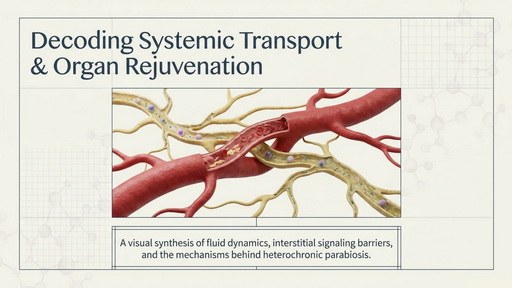
In the landscape of longevity research, few phenomena have been as provocative as heterochronic parabiosis—the surgical joining of the circulatory systems of a young and an old mouse. The results of these “vampire mouse” experiments are now legendary: the older mouse experiences systemic rejuvenation, while the younger mouse undergoes accelerated aging.
This leads us to a profound biological question: Is an organ’s age an immutable property, or is it a plastic state dictated by its environment? Recent dialogues among researchers, including Chen Long-bin and his colleagues, suggest that the “age” of an organ may simply be a reflection of the “biological soup” in which it is immersed. By examining the fluid dynamics of the kidneys and the lymphatic system, we are beginning to see how we might reset the biological clock by manipulating the systemic environment.
Takeaway 1: The Lymphatic System is a Biological Vacuum
To understand how we might “wash away” aging, we must look at the lymphatic system not just as a drainage network, but as a critical component of a systemic flushing loop. While the arterial system is driven by the positive pressure of the heart, the lymphatic system operates as a sophisticated “negative pressure” mechanism.
“The lymphatic circulation is a negative pressure; it will suck things from the tissue gaps into the system.”
This biological vacuum extracts materials from the interstitial space—the fluid-filled gaps between cells—and draws them into small lymphatic vessels. Guided by one-way valves that prevent backflow, this fluid moves through the lymphatic network until it is emptied back into the heart’s right atrium. This cycle is the only way for larger signaling molecules and metabolic byproducts to complete their journey from the tissue back into the central circulation. It is a one-way street essential for systemic communication and cellular “housekeeping.”
Takeaway 2: The “Brake” vs. “Gas” Theory of Aging
A central debate in geroscience is whether rejuvenation requires adding “young” factors (stepping on the gas) or removing “old” inhibitory factors (releasing the brake). The evidence increasingly suggests that the latter may be more effective.
Through systemic dilution—using saline or plasma exchange to lower the concentration of pro-aging proteins—we can trigger an organ’s innate self-repair mechanisms. When we dilute these inhibitory “brakes,” we create a “window” of comfort and repair. The transcript suggests that even a brief reduction in these factors—a half-hour or one-hour window—can allow the body to experience significant relief and restart regenerative processes.
“You just take off the brake and it will run.”
This implies that even in tissue that appears scarred or chronically aged, the remaining healthy cells retain the capacity to function. Rejuvenation, therefore, may not require a “Fountain of Youth” drug, but rather the removal of the obstacles preventing our bodies from maintaining themselves.
Takeaway 3: The Concentration Paradox (Picograms vs. Micrograms)
One of the most significant technical hurdles in blood-based rejuvenation is the Concentration Paradox. There is a staggering discrepancy between the levels of signaling proteins found in the blood and the levels required to elicit a cellular response in a laboratory setting:
- Picograms/Nanograms: The typical, highly diluted concentration of soluble proteins (like FGF or IGF) found in circulating blood.
- Micrograms: The concentration usually required in vitro to actually trigger a biological effect on a cell.
This discrepancy leads to a skepticism regarding soluble factors. If a signal is diluted to picogram levels in the blood, how can it possibly instruct an organ to repair itself? The answer likely lies in Enveloped Materials, specifically Exosomes (extracellular vesicles). Unlike soluble proteins that are lost in the vastness of the plasma, exosomes act as protected packages. They can carry high-density signals directly to a target, bypassing the dilution problem and delivering the “microgram-level” punch needed to change a cell’s behavior.
Takeaway 4: The Porous Gatekeepers of the Kidney
The kidney is not a passive filter; it is a sophisticated communication hub where blood and tissue “talk” through specialized gatekeepers called podocytes. These cells, located in the nephron, create a physical filtration barrier with remarkably precise pore sizes:
- 60 to 70 nanometers (nm)
- Up to 80 to 100 nanometers (nm) in specific regions
These gaps allow the kidney to act as a selective interface. By controlling which molecules and vesicles pass from the systemic circulation into the renal tissue, these pores dictate how the “Big Environment” of the blood influences the “Small Environment” of the organ. This is the site of the “systemic flushing loop”: materials move from the blood into the kidney via these podocyte gaps, and what is not utilized or excreted is “sucked” back into the circulation by the lymphatic vacuum.
Takeaway 5: The Transplant Proof—Old Organs in Young Bodies
The most compelling proof that the systemic environment dictates organ age comes from clinical transplant data. When a kidney from an older donor (e.g., 60 years old) is transplanted into a young recipient, the results are transformative.
The “old” kidney, once limited by the inflammatory and inhibitory factors of the aged donor, begins to function at a level significantly higher than it did previously. In the “Big Environment” of the young recipient, the organ effectively “becomes younger.” This clinical reality confirms that the functional age of an organ is not a fixed chronological sentence but is highly responsive to the fluid environment it bathes in. As long as the “brakes” are removed, the healthy cells within the organ can restart their youthful operations.
Conclusion: A New Horizon for Systemic Health
The frontier of longevity is shifting from genetic editing to systemic engineering. We are discovering that our organs are only as old as the fluid they bathe in. Rejuvenation may not require complex new molecules, but rather a sophisticated “cleaning” of our systemic environment—facilitating the natural cycle of filtration through the kidneys and suction through the lymphatics.
If we can maintain the “Big Environment” by balancing concentrations and clearing inhibitory factors, we move toward a future where aging is not an irreversible decay, but a manageable state.
If your organs are only as old as the fluid they bathe in, is “age” a permanent condition or a treatable environment?
Summary Video
Summary File